From the rock to savings
Your savings shape the world, yet nobody asks you which one. This thesis starts from that observation, travels through Paris asset management firms and then lands on Belle-Île-en-Mer to imagine a fund that residents would build together with their funders.
The starting question: could a foresight approach applied to asset management help build a model of regenerative finance?
Yesterday, today, and two tomorrows
Before entering the thesis, a look at Belle-Île through time. The climate is changing whatever we do. What remains open is how the island prepares for it: that is what foresight is all about.
Action research in five stops
This is not a desk study. The author, who spent eight years at the (French pension reserve fund), tested his idea in the field and put it to those who might finance it. The method changed along the way, and the thesis says so openly.
An “off-the-ground” finance
Asset managers handle trillions of euros of savings. Yet the thesis describes a sector that copies itself, looks in the rear-view mirror and never talks to the people whose money it manages. Click on each link in the chain.
, or why changing the words is not enough
The philosopher John L. Austin showed that some sentences do not describe the world: they act on it. “I promise”, “I now pronounce you married”. The sociologist Michel Callon applied the idea to economics: a financial theory that everyone applies ends up producing the reality it claims to describe.
The thesis draws a simple observation from this. “Performance finance” became “responsible”, then “sustainable”, soon “impact”. The vocabulary changes. The data in circulation stays the same. Try it.
“See far, see wide, see deep, take risks and think of humankind”
Gaston Berger, one of the fathers of foresight. The thesis translates his formula for an asset manager.
The sayings taught to traders
In 2005, the author trained in trading with a former Chicago Mercantile Exchange trader. He came away with a collection of proverbs. The thesis sees in them a worldview passed on without being questioned. Flip the cards: the back offers a reading in the light of the thesis.
Bonus: “Better to be wrong with everyone else than right on your own” and “Never follow the others like sheep, sheep get shorn” appear on the same list.
Belle-Île, an open-air laboratory
Why an island? Because everything that comes in and goes out passes through a boat or a cable. Flows are traceable and tensions show quickly. The interviews brought out seven issues. Tap the markers.
Schematic map · 17 km × 9 km · 85.63 km²
The month-by-month curve is an illustration: the thesis gives the two end points (5,386 and about 45,000). In between, a shopkeeper in Le Palais makes most of her turnover in three to six months, hence the difficulty of hiring year-round.
The personas interviewed
Twenty-four people met during the research, presented by their role. The faces are imaginary. Click on a card to read the profile.
Maud’s whey
The thesis defends one idea: we finance better what we can tell as a story. Its favourite example comes from a cheesemaker on the island who, without setting out to, built a small regenerative model. Follow the milk.
An electric composter for the island
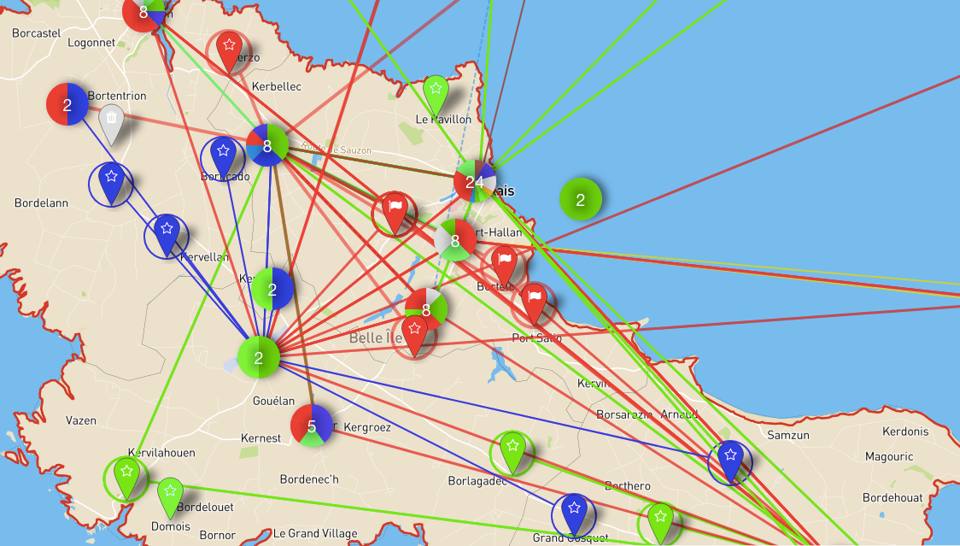
On Belle-Île, every farmer buys imported inputs that are expensive to bring in. Meanwhile, organic waste piles up. The idea: compost locally and sell the compost to producers. In July 2020, the author mapped the project’s flows in the tool.
They supply the organic waste
They buy the compost
How to finance it?
The thesis stacks the funders, each in its place: a regional grant to get started, solidarity finance networks, a crowdfunding platform to get people talking about the project, then an impact fund.
Local contributors would be repaid in vouchers for producers’ baskets, as in aeronautics where the first customers get a discount on the first orders.
Where is the impact?
- Organic waste turned into value on site instead of being buried or shipped out.
- Soils richer in organic matter, fewer chemical inputs.
- Fewer greenhouse gases (transport, nitrous oxide).
- Higher margins for producers, jobs, know-how brought back home.
- A story the island can be proud of, enough to “keep the local gossip going for several weeks”.
The power of narrative
This is the argument that runs through all four parts. Finance does not run on numbers alone: it runs on stories that a community believes in. If we want to change what it finances, we have to change the story it tells itself.
“A false but clear and precise idea will always have more power in the world than a true but complex one.”Alexis de Tocqueville, quoted in Part II
The thesis draws on Merton’s (1948): “what we think determines what we do, but also what happens to us”. A financial theory does not need to be true to prevail. It only needs to be believed, practised, and to reassure those who apply it.
Asset management firms know this. To stand out, they build themselves a myth: the . Daniel Kahneman explains it: these stories offer “a simple message of triumph and failure that identifies clear causes and ignores the determinative power of luck”.
Hence FINeCOS’s bet: use the same mechanism, but in the service of other futures. “Build the self-fulfilling prophecy.”
1. Two stories, the same structure
Every story has a hero, a setting, a quest, an adversary. Compare the one finance tells today with the one the thesis proposes.
2. Casting the roles
“The idea being to value the whole value chain (gratitude) so that everyone wants to become its Hero.” In the FINeCOS version, there is not one hero but a whole cast.
3. The good-story workshop
The model is Maud’s whey: someone local turns something dormant into a resource, and everyone benefits. Make your own, then put it through John Kotter’s “vision” test, which the thesis borrows.
A game: some combinations are far-fetched. The best ones resemble projects spotted on the island.
“It is no longer enough to write a story with a beginning and an end. We must write a plural story that can regenerate and feed itself.”Summary of Part III
“When you do something good, you have to show it, otherwise others will take care of doing it in your place.”Part IV, on communicating local projects
Financiers are ready to hear it. A private equity player sums it up: “In the end, in private equity, we like a good story.” And once financed, projects in turn become ambassadors and mentors for the next ones. The story tells itself.
FINeCOS, a territory in common
The thesis’s proposal: a . Residents imagine the future of their territory together and identify the projects that answer it, and funders use it as a pipeline. The saver takes back control over the “what”; the asset manager keeps the “how”.
1. A community of anticipation in six stages
First circle: the town council. Second circle: volunteer citizens, or even citizens drawn by lot. The plan would be voted on by everyone, like a participatory budget, with an incentive to bring in minorities too (a property tax reduction, for example).
2. A playing field for each funder
A large asset manager cannot directly finance a composter: the ticket is too small, the asset is unlisted, and it cannot sell it quickly. The thesis proposes layers. Choose the project stage.
Grouping by stage suggested for readability, based on the thesis’s financing options.
3. A financial innovation lab
To move from prototype to a real programme, the thesis imagines a shared structure, governed as a commons so that no single actor can take it over.
Earthworms
“FINeCOS is not dedicated to building chimeras, Dahus, Unicorns, but to building earthworms: unseen beings that work every day, useful, real and providing many ecosystem services: our SMEs.”
What gets in the way (and what we heard)
The project submitted to an insurer’s call for projects gathered nearly 200 votes from about a thousand contacts, but was not selected. The thesis keeps a list of its own blind spots. Here is the wall of phrases heard along the way.
The biases the author acknowledges
A former insider, the author probably steered the interviews with asset managers more, “perhaps out of a desire to convince”.
The central link was not interviewed directly. The author’s job in an asset management firm serves as a “degraded, totally imperfect proxy”.
A small, isolated territory makes observation easier, but it is not representative. Hospitality, energy and fishing are also missing.
The programme openly treats climate, biodiversity and resources as basic, non-negotiable rules.
“Arriving on Belle-Île with a financial angle is a very bad idea. So you have to take the time to get it right.”The thesis, section 4.2
The words of the thesis
Terms with a dotted underline on this page open when clicked. Here they all are, to explore.
Six questions to check the crossing
The ferryman has the boat. Now to choose the shore.
The thesis closes on an image. The asset manager is a bridge between two shores: savers on one side, projects to finance on the other. It has the capacity to connect them. It does not necessarily have the will yet, nor the tools.
Finance has the savings and the expertise. But it decides with backward-looking models, copies itself and speaks a language that keeps savers at arm’s length. As long as the only story told is that of financial performance, it will finance probable futures rather than desirable ones.
On Belle-Île, there is no shortage of ideas: composting organic waste, reviving a local flour, keeping water, keeping young people. They fly under the radar because they are small, unlisted, and led by people whom few come to listen to. On the island, you do not arrive as a financier: you take your time, you come “on behalf of someone”.
FINeCOS offers a method more than a product: a community of anticipation that imagines the future of the territory, funders that each step in at their own scale, and local stories that make people want to invest. Not unicorns: earthworms.
“If the IPCC simulations are right, sustainable will no longer be enough, because to last, we will have to recreate.”General conclusion of the thesis
What remains open
- The saver, the great absentee from the chain, was also absent from the research. Now they need to be heard directly.
- The prototype did not go as far as a full financial simulation.
- A pilot territory is missing, as are funders ready to try.
- Cooperation takes time: elected officials, entrepreneurs and financiers do not work at the same pace.
What now?
This thesis is not an end. What comes next happens in the field, through intervention research: experimenting, with asset managers and insurers, with designing financial products together with their savers, in the service of a territory.
If this topic speaks to you, let’s talk.
Discuss an experiment“The FINeCOS programme may hold this gentle utopia, which is no longer one.”
Five questions to ask about your territory
The thesis concludes that the programme must first stay simple and get to the essentials. It suggests starting with these questions, which apply well beyond Belle-Île.
What allows you to live and make your home in your territory sustainably, every day?
What would you agree to finance with your savings to meet that need?
Over what period?
What would be a fair return on savings invested in projects that improve your own well-being, locally?
Which pillars of a local economy need to be regenerated in order to last?
Read the full thesis (in French)
This journey simplifies a 236-page work, its references and its interview appendices. For the full argument, the bibliography and the method, nothing replaces the original.
- Title
- Could a foresight approach applied to asset management help build a model of regenerative finance?
- Author
- Alexandre Van Ooteghem
- Degree
- Master’s degree in Innovation, Business and Society, Foresight, Innovation and Organisational Transformation track
- School
- Conservatoire national des arts et métiers (CNAM)
- Supervisor
- Maryse Carmes, Dicen-IDF laboratory
- Years
- 2019–2021
Bibliography
No reference matches.